Syntellix July 15, 2025
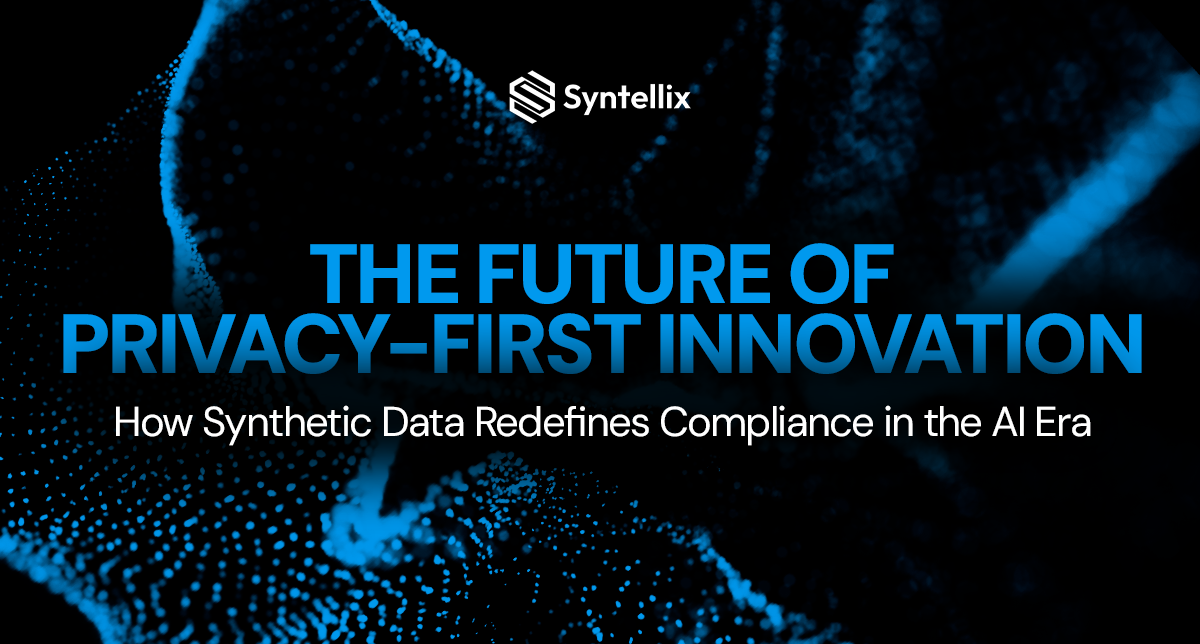
The Future of Privacy-First Innovation: How Synthetic Data Redefines Compliance in the AI Era
As artificial intelligence continues to transform the global economy, one truth becomes increasingly clear: data is no longer just a resource—it’s a responsibility.
Enterprises are now expected to build AI systems that are not only accurate and scalable but also privacy-preserving, explainable, and compliant with global regulations. In this context, synthetic data has emerged not as a secondary option but as a strategic cornerstone for modern, ethical AI development.
From Anonymization to Synthesis: A Necessary Evolution
Historically, companies relied on data anonymization to mitigate privacy risks. But as re-identification techniques have become more sophisticated, anonymization has proven to be insufficient and increasingly non-compliant with standards like:
GDPR (EU)
CCPA (California)
PIPEDA (Canada)
HIPAA (U.S. healthcare)
In contrast, synthetic data—entirely generated by algorithms and statistically consistent with real-world datasets—offers a robust solution that breaks the link to identifiable individuals entirely. This shift marks a critical evolution in how we handle data in regulated environments.
Why Compliance Is No Longer Optional
Regulatory frameworks are becoming stricter, and enforcement is growing stronger. Companies now face mounting pressure to:
Limit access to sensitive datasets
Demonstrate privacy-by-design practices
Maintain explainability in model behavior
Prove that training data does not expose user identities
Synthetic data meets these requirements by default, allowing teams to move quickly while maintaining airtight compliance.
The Enterprise Case: Speed, Cost, Safety
Forward-thinking companies are already shifting from model-centric to data-centric development, where the quality, control, and diversity of training data become the differentiators.
Benefits of synthetic data for enterprises include:
- ⚡ Speed: Generate diverse, ready-to-train datasets without the delays of data collection or labeling
- 💸 Cost-efficiency: Eliminate the overhead of securing, anonymizing, or cleaning sensitive real-world data
- 🔐 Safety: Ensure no exposure of personally identifiable information (PII) or protected health data
- 📊 Scalability: Create domain-specific datasets for edge cases, rare events, or multilingual contexts
- 📄 Audit-readiness: Align with compliance requirements through documented data generation processes
Platforms like Syntellix exemplify this new approach by offering high-quality synthetic data across image, text, and tabular formats—tailored for enterprise AI teams operating in tightly regulated spaces.
Why It Matters: Unlocking Innovation Without Compromise
Whether it's training NLP models in financial services, building fraud detection systems in banking, or powering diagnostic tools in healthcare, access to secure, diverse, and regulation-ready data is essential.
Synthetic data is not a shortcut—it’s a strategic enabler that allows innovation and compliance to coexist. And in an era where trust, transparency, and fairness are not just ethical ideals but business requirements, this distinction matters more than ever.
The future of AI doesn’t just belong to the fastest or most technically advanced—it belongs to the most responsible. As we build systems that influence medical decisions, financial access, and social outcomes, the source and nature of the data we use will define the quality of the AI we produce.
Synthetic data stands at the intersection of innovation and integrity. It empowers organizations to scale securely, iterate faster, and lead responsibly, without compromising on performance or compliance.
Conclusion
Synthetic data is transforming how organizations approach AI development, offering a path forward that balances innovation with responsibility.