Syntellix October 5, 2025
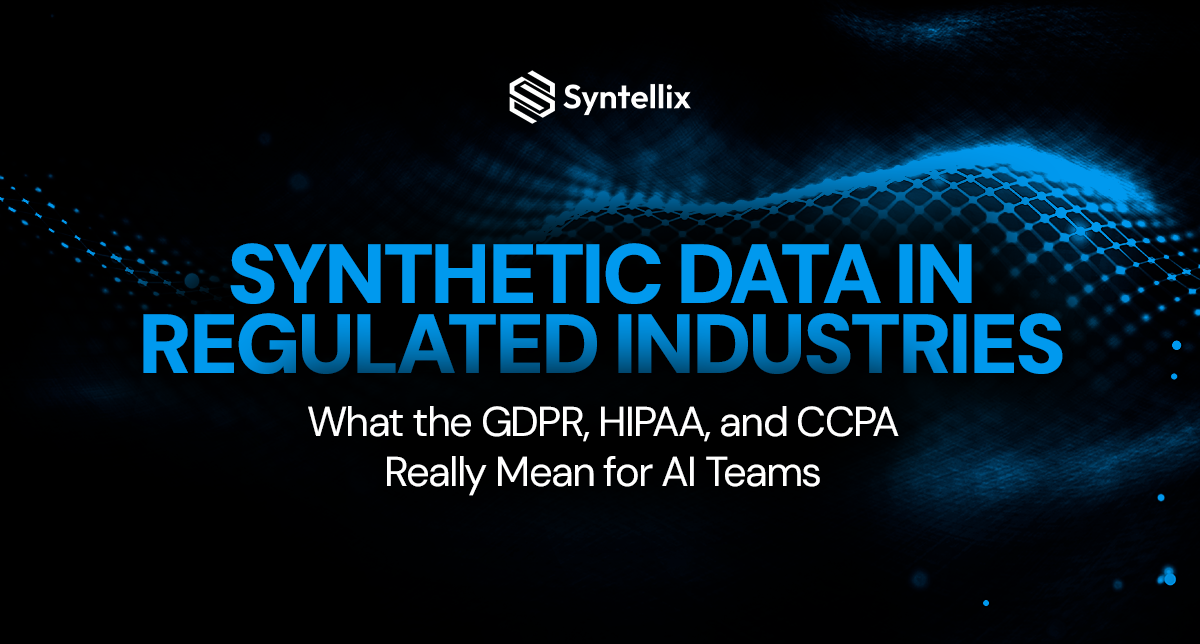
Synthetic Data in Regulated Industries: What the GDPR, HIPAA, and CCPA Really Mean for AI Teams
Your practical guide to staying compliant while scaling your data strategy.
In today’s AI-driven world, data is currency, but in regulated industries, it can feel more like a liability than an asset. From hospitals to hedge funds, teams are innovating under a microscope of legal scrutiny.
🔍 How do you train accurate models when you're handcuffed by privacy regulations? 💡 How do you innovate without risking fines, breaches, or reputational damage?
The answer is increasingly clear: synthetic data.
🧩 The Compliance Puzzle: GDPR, HIPAA, CCPA
Let’s break down what these frameworks really mean for AI development:
🛡️ GDPR (EU)
Applies to any data tied to identifiable individuals
Limits use of personal data in training or analytics, even if anonymized
Consent and data minimisation are core principles
Reidentification risk = non-compliance
🩺 HIPAA (US Healthcare)
Restricts use of patient health information (PHI)
Requires strict controls for de-identification and disclosure
Training AI models on real patient data is often non-viable
🔒 CCPA (California)
Grants consumers the right to know, delete, or opt out of data sharing
Imposes fines for improper data handling or sale
Applies even if you're only operating online with California users
The result? AI teams face red tape at every step, from data access and sharing to model validation.
🚧 Why Traditional Anonymisation Isn’t Enough
Many teams rely on anonymised data to train models—but anonymisation is fragile:
Reidentification is often possible with just a few data points
It doesn’t fully remove risk under GDPR or HIPAA
De-identified data may still carry historical bias and lack edge cases
What you gain in legal “safety,” you often lose in model quality and fairness.
💡 Synthetic Data: A Scalable, Safe Alternative
Synthetic data is artificially generated data that maintains the statistical fidelity of real-world data, but contains no actual personal or sensitive information.
At Syntellix, we empower AI teams to:
Generate high-fidelity datasets from real-world patterns
Avoid PII entirely—removing the legal burden
Test edge cases without privacy risk
Create shareable, sandbox-ready datasets for R&D and product testing
In essence: privacy by design. Innovation by intention.
🧠 Use Cases Across Regulated Sectors
Healthcare AI → Simulate patient populations for diagnostic model training without touching PHI.
Banking & Fintech → Create fair, bias-mitigated credit models and simulate fraud events without breaching CCPA.
Insurance & Actuarial Modeling → Stress-test pricing models with synthetic portfolios across age, geography, and health status.
Public Sector & Research → Enable academic, policy, or ML research without navigating layers of legal consent.
🔍 Compliance Isn’t a Barrier; It’s a Catalyst
Regulations are not meant to halt innovation. They’re meant to protect individuals. Synthetic data offers a bridge,turning regulation into a framework for more responsible, robust AI.
When AI systems are trained on synthetic datasets:
There’s no risk of PII exposure
Compliance teams can sleep at night
Legal review doesn’t stall your R&D cycles
You can share data cross-border, cross-team, cross-function
🛠️ Build Responsibly, Scale Freely
At Syntellix, we don’t just generate synthetic data. We generate confidence, that your innovation won’t come at the cost of privacy, compliance, or ethics.
- 📌 Ready to scale your AI capabilities while staying 100% compliant? Let’s talk: www.syntellix.ai
Conclusion
Synthetic data is transforming how organizations approach AI development, offering a path forward that balances innovation with responsibility.